What this field involves
Understand cloud data-warehouse concepts, SQL-based analysis and the operational choices involved in loading, transforming and sharing data.
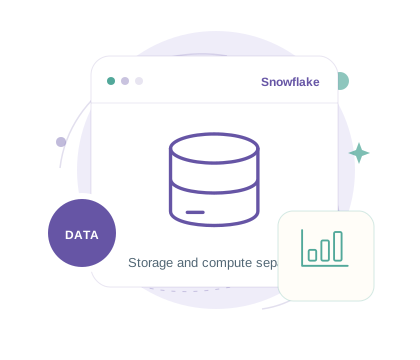
- Storage and compute separation
- SQL transformation and loading patterns
- Roles, permissions and data sharing
- Performance and cost awareness
Understand the learning journey
Snowflake & Cloud Data Warehousing learning roadmap
Use this roadmap to understand the subject and discuss your goals. Confirm the exact syllabus, tools and practical access for the batch you choose.
01Map analytical data needs
Define the source systems, query users, refresh requirements and business measures. Distinguish operational transactions from analytical reporting workloads.
02Understand platform responsibilities
Discuss storage, compute and access boundaries at a conceptual level. Relate resource choices to the workload rather than selecting a larger configuration by default.
03Load and validate data
Plan ingestion with clear formats, types and error handling. Check whether a rerun repeats records and how failed inputs are investigated.
04Model useful analytical tables
Choose consistent keys, grain and transformation rules. Reconcile important measures against source examples before sharing the resulting dataset.
05Review security and sharing
Discuss roles, privileges and the handling of sensitive data. Treat data sharing as an access decision that needs explicit ownership and review.
06Observe cost and operation
Plan query review, resource suspension and lab cleanup. Confirm account access, platform edition and programme scope before starting exercises that can incur charges.
Useful foundations
Strong SQL foundations, relational-data concepts and familiarity with files or ETL workflows are useful.
A practical question to investigate
Model a small analytical warehouse, define a repeatable loading process and describe how access permissions and compute usage would be reviewed.
This is an illustrative learning brief, not a promise about an SV Infotech batch or its project assignments.
Make progress visibleWhat a useful practice review can show
Use these checkpoints to assess an example exercise and identify what to practise next.
- Explain table grain
- Detect a repeated load
- Describe a role boundary
- Identify a cost-control step
Put the ideas into contextSnowflake & Data Warehousing: a worked study example
Illustrative scenario for discussion and self-study.
Design a fictional sales warehouse with one row per invoice line and separate product and date information. Define how a sales metric should handle returns and late corrections. Explain who may query sensitive fields before considering platform features or performance settings.
What to check in your work
- Document the grain and business meaning of each metric.
- Keep access and retention questions visible in the design.
How this pathway compares
A warehouse supports organised analytical data. Oracle SQL and PL/SQL strengthens relational reasoning, while Power BI shows how models and metrics are consumed in reports. Confirm the platform and practical access of any proposed programme.
Take the next small stepSnowflake & Cloud Data Warehousing: a quick self-check
What should a cloud warehouse task define before discussing scaling?
Read the explanation
Define the data being loaded, the query task, expected freshness and a way to check the result. Consider permissions, workload isolation and cost observation. Confirm the actual account configuration before assuming that a demonstration's capacity or features apply everywhere.
A self-study aid for exploring the subject. Confirm the actual syllabus, practical access and class arrangements with the office.
Before choosing a programme
Is a data warehouse just a copy of an application's database?
It often reorganises data for historical and cross-source analysis. Grain, business definitions, change handling and access requirements can differ from those of the operational application.
Should I learn SQL before Snowflake?
Yes, a working knowledge of joins, aggregation, table design and query behaviour gives the platform features context. Platform navigation does not replace the ability to reason about data and write clear SQL.
Can I join the Snowflake & Cloud Data Warehousing batch at SV Infotech?
Contact the team to confirm whether this programme is currently offered, its entry requirements and the available training arrangements. Fees, duration, trainer and batch dates are provided after confirmation.
Review the official learning or product documentation ↗ to understand the technology. Product references do not imply vendor affiliation, accreditation or certification.
Further reading for Snowflake & Cloud Data Warehousing
Explore these official or publisher-maintained resources alongside your learning. Resource links do not imply affiliation, certification or a confirmed course syllabus.
Choose your learning format
Planning your Snowflake & Cloud Data Warehousing learning route
Learn in Dilsukhnagar
This Snowflake & Cloud Data Warehousing page is a programme guide. Use it to understand the field and compare related published courses at SV Infotech in Dilsukhnagar, Hyderabad. The guide does not confirm that a separate programme or batch is currently available.
Explore Hyderabad training options →Enquire from anywhere
If you are exploring Snowflake & Cloud Data Warehousing from another city or country, send an online-learning enquiry with your starting level and time zone. Ask the team to confirm whether suitable training is offered, which topics are covered and how practical work would be supported.
Ask about online Snowflake Data Warehousing learning →Prepare the right data and computing setup
Discuss your operating system, Python or SQL starting level, and whether exercises run locally or need a cloud account. Ask about sample datasets, account permissions and any third-party usage charges before creating paid cloud resources.
Can I enquire about Snowflake & Cloud Data Warehousing from outside India?
Yes. Share your country, time zone and learning goals in the enquiry form. The team will confirm availability, suitable timings and the practical setup for your location. A programme guide is not confirmation of an available course.
What should I confirm before choosing a learning format?
Strong SQL foundations, relational-data concepts and familiarity with files or ETL workflows are useful. Ask about the current syllabus, how exercises are reviewed, software or system access and the support available. Confirm fees and dates directly with the team.